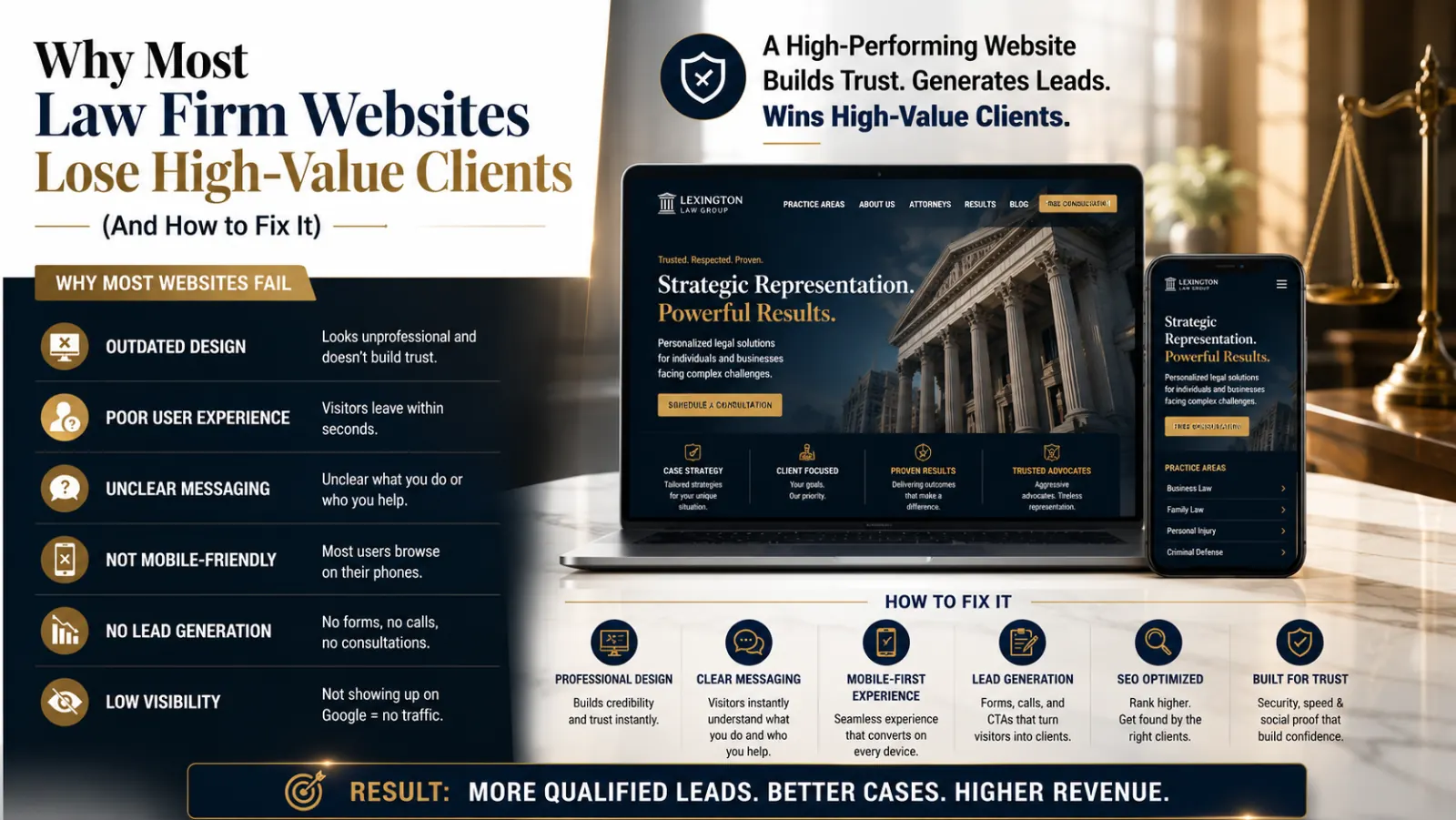
Are you a legal professional losing cases to competitors with better digital presence? Discover how smart UI/UX design and targeted WordPress customization turn your law firm's website into a powerful client generation tool.
Your law firm's website is often the first impression a potential client gets of your practice. In a competitive market like Australia's, where top-tier commercial clients and high-net-worth individuals are choosing between dozens of firms, that first impression can make or break a retainer. Yet the vast majority of Australian law firm websites are haemorrhaging valuable enquiries every single day, not because the firm lacks expertise, but because the website fails to convert visitors into clients.
This article breaks down exactly why that happens and, more importantly, what you can do about it.
The Trust Gap: Why Visitors Leave Without Enquiring
The legal profession is built on trust. When a managing partner at a Sydney ASX-listed company is searching for a corporate law firm, or when a Melbourne family navigating a complex estate dispute lands on your site, they are making a high-stakes decision. The website needs to do the trust-building work that a referral or a partner introduction would traditionally do.
Most law firm websites fail at this because they are built around the firm's perspective, practice area lists, partner profiles with headshots from 2017, and a generic "we are committed to excellence" headline. This is inward-facing communication. Clients are looking for outward-facing signals: evidence that you understand their specific problem, that you have solved it before, and that contacting you carries no risk.
The fix starts with language. Rewrite your homepage headline around the client's situation, not your credentials. Instead of "Commercial Litigation Specialists, 30 Years of Experience", consider "Protecting Melbourne Businesses in High-Stakes Commercial Disputes." The difference sounds subtle; the conversion impact is not.
Slow Load Times Are Costing You Clients in Australia's Mobile-First Market
Google's Core Web Vitals data consistently shows that Australian users, particularly those browsing on mobile networks in Queensland, Western Australia, and regional areas, abandon websites that take longer than three seconds to load. Legal clients are no different. A prospective client who found your firm through a Google search for a Sydney family lawyer has three or four other tabs open. If your website is slow, they are gone.
Common culprits on Australian law firm websites include:
- Oversized team photography served without modern image formats like WebP or AVIF
- Hosting on legacy shared servers based offshore rather than Australian data centres
- Bloated page builders with excessive plugin overhead
- No caching layer or content delivery network (CDN) configuration
A technically optimised website does not just improve user experience, it directly improves your ranking position in Google Search, which is where the overwhelming majority of new client acquisition in the legal sector now begins. PageSpeed scores above 90 on mobile are achievable for most law firm sites and should be a baseline requirement, not an afterthought.
The Contact Page Problem: Friction Is Your Biggest Competitor
Ask yourself: how many steps does it take for a prospective client to send your firm an enquiry? If the answer is more than two, you are losing business. Yet it is astonishingly common for Australian law firm websites to require visitors to navigate to a separate contact page, fill out a form with eight or more mandatory fields, solve a CAPTCHA, and then wait for a response with no indication of timeframe.
Every additional field in an enquiry form reduces submission rates. Research from conversion optimisation studies consistently shows that reducing form fields from ten to four can more than double conversion rates. For a law firm, you need a name, an email address or phone number, and a brief description of the matter. Everything else can be gathered during the initial consultation.
Equally damaging is the absence of urgency signals. If someone has just received a Supreme Court filing or discovered their business partner has been diverting funds, they are not going to wait 48 hours to hear back. Adding a clear statement, "We respond to all new enquiries within two business hours", alongside a direct phone number prominently displayed in the header can have an immediate and measurable impact on enquiry volume.
Practice Area Pages That Actually Rank and Convert
The structure of your practice area pages is arguably the single most important factor in both search visibility and client conversion for Australian law firms. A page titled simply "Family Law" with three paragraphs of generic content will neither rank for competitive searches nor persuade a distressed client that you are the right choice.
Effective practice area pages for law firm website conversion need to:
- Speak to a specific client situation, for example, a property settlement page should address the concerns of someone going through divorce in Australia, including relevant considerations under the Family Law Act 1975 and the role of the Federal Circuit and Family Court
- Demonstrate jurisdiction-specific knowledge, clients in New South Wales want to know you understand the NSW Supreme Court, NCAT, or the specific regulations of the Law Society of New South Wales
- Include social proof, anonymised case outcomes, client testimonials compliant with your state law society's advertising guidelines, and relevant accreditations
- End with a clear, low-friction call to action, not a generic "contact us" but something specific like "Arrange a confidential 30-minute consultation"
For firms practising in regulated areas, particularly those who hold a current practising certificate through bodies such as the Legal Practitioners Education and Admission Council (LPEAC) or equivalent state bodies, communicating that accreditation clearly on relevant pages significantly increases trust signals for prospective clients who are actively evaluating their options.
The Mobile Experience: Where Australian Law Firm Websites Fall Apart
More than 60 per cent of legal searches in Australia now originate on a mobile device, yet the vast majority of law firm websites were designed desktop-first and retrofitted for mobile, badly. The result is pinch-zooming partner profiles, contact forms that overflow the viewport, and phone numbers that are not click-to-call enabled.
A properly designed mobile experience for a law firm website means:
- A phone number in the header that dials immediately when tapped
- Navigation that collapses cleanly without obscuring content
- Forms that are native-mobile-friendly with appropriate keyboard types triggered for email and phone fields
- Touch targets large enough to use without zooming
- Content legible without horizontal scrolling at 375px viewport width
This is not just a usability issue, Google uses mobile-first indexing, meaning its crawlers assess the mobile version of your site to determine rankings. A poor mobile experience directly suppresses your visibility in searches for terms like law firm website design Sydney or commercial lawyers Melbourne.
Credibility Architecture: Building Authority Before the First Call
High-value clients, whether they are corporate counsel at a Brisbane resources company or a private client managing a complex succession matter, conduct due diligence before they pick up the phone. Your website needs to give them enough evidence of credibility to make that call with confidence.
The elements that matter most in the Australian legal market include:
- Genuine partner profiles with specific areas of expertise, notable matters, admission year, and a professional photograph taken within the last two years
- Published thought leadership, articles commenting on recent High Court of Australia decisions or changes to the Corporations Act position your firm as genuinely knowledgeable
- Verifiable awards and recognitions such as Doyle's Guide rankings, Chambers and Partners listings, or Law Institute Victoria accreditations
- Specific client testimonials, "Helped us navigate a complex PPSA dispute with a favourable outcome" is far more credible than "Excellent service"
- Fee transparency, even a brief statement that you offer fixed-fee options for certain matters significantly reduces the primary barrier to enquiry in the Australian legal market
Turn Your Law Firm Website Into a Client Acquisition Asset
The firms that win online in Australia's legal market are not necessarily the largest or most prestigious. They are the ones that treat their website as a client acquisition asset rather than a digital brochure, investing in technical performance, conversion-focused design, practice area content that speaks directly to client concerns, and a flawless mobile experience.
The changes required are not always dramatic. Restructuring a homepage headline, cutting form fields, compressing images, and rewriting one or two practice area pages with genuine client empathy can produce a measurable uplift in enquiry volume within weeks, without increasing your marketing spend at all.
At Acroxcreation, we specialise in designing and developing websites for professional services firms across Australia that are built to convert, technically optimised, strategically structured, and designed to communicate your firm's authority from the first page load. Get in touch with the Acroxcreation team today for a no-obligation conversation about your firm's website.