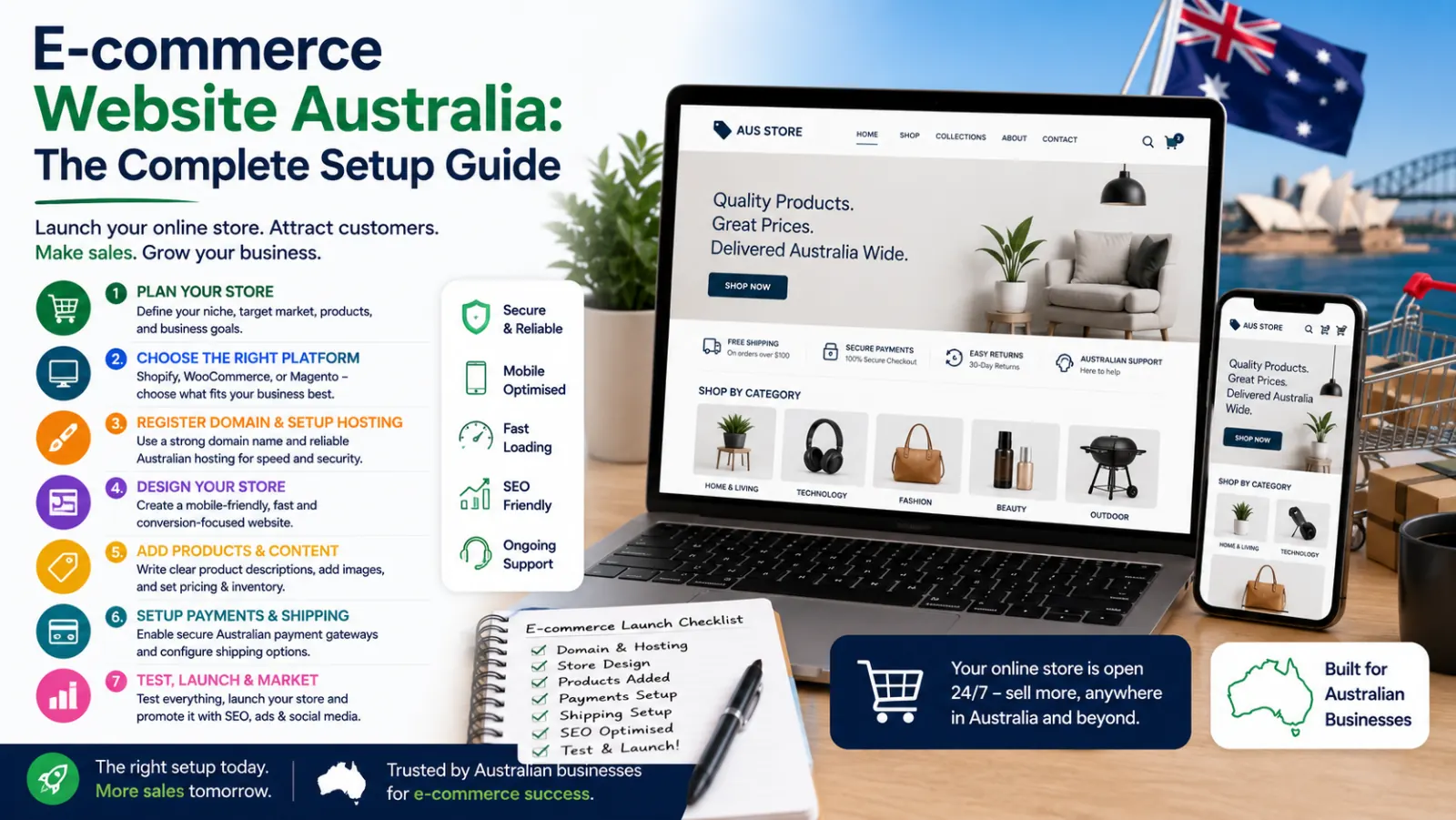
Everything Australian businesses need to set up an e-commerce website: platform choices, Afterpay and Zip integration, GST configuration, and conversion tips.
Australian e-commerce has never been more accessible, or more competitive. Online retail in Australia is now a $60+ billion industry, and small businesses that establish a well-built online store are capturing genuine revenue from customers who'd otherwise shop with the major retailers or scroll international sites. But getting your e-commerce setup right from the beginning makes an enormous difference to your profitability, your customer experience, and your sanity.
Choosing the Right E-commerce Platform for an Australian Business
Platform selection is the most consequential decision you'll make in your e-commerce journey. Each major option has a genuine use case, there's no single correct answer, but there is a right answer for your specific business:
Shopify
Shopify is the dominant e-commerce platform globally and has strong Australian adoption. It's cloud-hosted, requires no technical maintenance, and has an enormous ecosystem of apps and integrations. Best suited for: product-based businesses with 10–10,000+ SKUs who want fast setup, reliable hosting, and access to a wide app marketplace. Monthly costs range from $49–$399 AUD per month plus 0.5–2% transaction fees (waived if using Shopify Payments, which is available to Australian merchants).
WooCommerce (WordPress)
WooCommerce is a free plugin that turns a WordPress site into a full-featured store. It's highly customisable and gives you complete control over your data and codebase. Best suited for: businesses that want maximum flexibility, already have a WordPress site, or need custom functionality not available in SaaS platforms. Requires hosting management and more technical oversight than Shopify. Hosting costs from $20–$100+ AUD per month.
Squarespace Commerce
Best suited for: Small catalogues (under 50 products) where design aesthetics are a priority, photographers selling prints, designers selling merchandise, or boutique makers. Limited compared to Shopify or WooCommerce for serious growth.
BigCommerce
A strong Shopify alternative with more built-in features and no per-transaction fees. Best suited for: businesses expecting high volume who want lower ongoing percentage costs and strong B2B capabilities.
Australian Payment Gateways: Getting Paid Properly
Australian shoppers have strong expectations around payment options. Offering a narrow range of payment methods is a direct cause of cart abandonment. Your store must support:
Credit and Debit Cards
Stripe is the most developer-friendly option and integrates with every major platform. Square is excellent for businesses also selling in-person. Both have Australian entity support and AUD settlement.
PayPal
Despite its age, PayPal remains important for Australian shoppers, particularly in the 35+ age demographic and for higher-value purchases where buyers want PayPal's buyer protection. Don't omit it.
Buy Now Pay Later: Afterpay and Zip
This is where Australian e-commerce diverges most significantly from global norms. Australia leads the world in BNPL adoption, and Afterpay in particular is a genuine purchase driver for many product categories. Offering Afterpay on an Australian fashion, homewares, or beauty e-commerce store can increase average order values by 20–30%. Key points:
- Afterpay: No credit check for customers, four fortnightly payments, merchant fees of approximately 4–6% per transaction
- Zip: Broader spending limits, longer repayment terms, popular for higher-value purchases like electronics or homewares
- Latitude Pay and Humm: Worth considering for stores with higher average order values
Apple Pay and Google Pay
One-tap mobile checkout that dramatically reduces friction on smartphones. These should be enabled by default, they're increasingly expected by Australian mobile shoppers.
GST Configuration: Getting the Tax Right
GST handling is a common point of confusion for Australian e-commerce businesses. Key rules:
- If your business is GST-registered (turnover over $75,000 AUD per year), you must collect 10% GST on all Australian sales
- Product prices can be displayed inclusive or exclusive of GST, but the GST amount must be clearly indicated at checkout
- For international customers, GST does not apply to most exported goods
- Digital products sold to Australian customers are subject to GST regardless of where the seller is based (the so-called "Netflix tax" introduced in 2017)
- Your platform must generate tax invoices, Shopify and WooCommerce both support Australian GST invoice generation with the correct configuration
Always consult your accountant or BAS agent for your specific tax situation, incorrect GST treatment can create significant compliance issues at BAS time.
Shipping and Fulfilment for Australian Stores
Shipping is a major friction point for Australian consumers, given the country's size and the expectation for fast delivery in metropolitan areas. Consider:
- Australia Post eParcel: The default for most Australian small e-commerce businesses. Integrates with Shopify and WooCommerce via StarShipIt or directly.
- Sendle: Often cheaper than Australia Post for parcel delivery, particularly for small businesses. Strong in metropolitan areas.
- CouriersPlease and Fastway: Competitive for national delivery with good tracking.
- Free shipping thresholds: Offering free shipping above a minimum order value (typically $50–$100 AUD) measurably increases average order value for most Australian stores.
Product Pages That Convert
An Australian e-commerce site lives and dies on its product pages. The non-negotiables:
- Multiple high-quality product photographs including scale reference, detail shots, and lifestyle imagery
- Clear, scannable product description that answers the top three buyer questions
- Obvious, prominent pricing in AUD with GST clearly noted
- Trust badges: secure checkout, returns policy, Australian owned/operated if applicable
- Real customer reviews, Okendo and Yotpo integrate well with Australian stores
- Related product recommendations to increase average order value
- Clear stock status, "Only 3 left" creates genuine urgency
Mobile-First Checkout Optimisation
Over 60% of Australian e-commerce purchases are now completed on a mobile device. If your checkout isn't optimised for thumbs, you're losing sales at the finish line. Mobile checkout must:
- Autofill addresses from Google Places
- Show one-tap payment options (Apple Pay, Google Pay, Afterpay) first
- Minimise the number of form fields
- Allow guest checkout, forced account creation is the leading cause of cart abandonment
Legal Requirements for Australian E-commerce Stores
Before launch, ensure you have:
- Privacy Policy: Required under the Australian Privacy Act 1988
- Returns Policy: Australian Consumer Law gives consumers statutory rights regardless of your policy, your policy should reflect these rights
- Terms and Conditions: Covering product descriptions, liability limitations, and dispute resolution
- ACCC-compliant pricing: No misleading "was/now" pricing; all advertised prices must be genuine
Building an Australian e-commerce store that actually generates revenue requires more than uploading products and hoping for the best. If you want a store that's configured correctly from the start, right payment gateways, right tax setup, right mobile experience, contact Acroxcreation. We build e-commerce websites for Australian businesses that are designed to sell from day one.