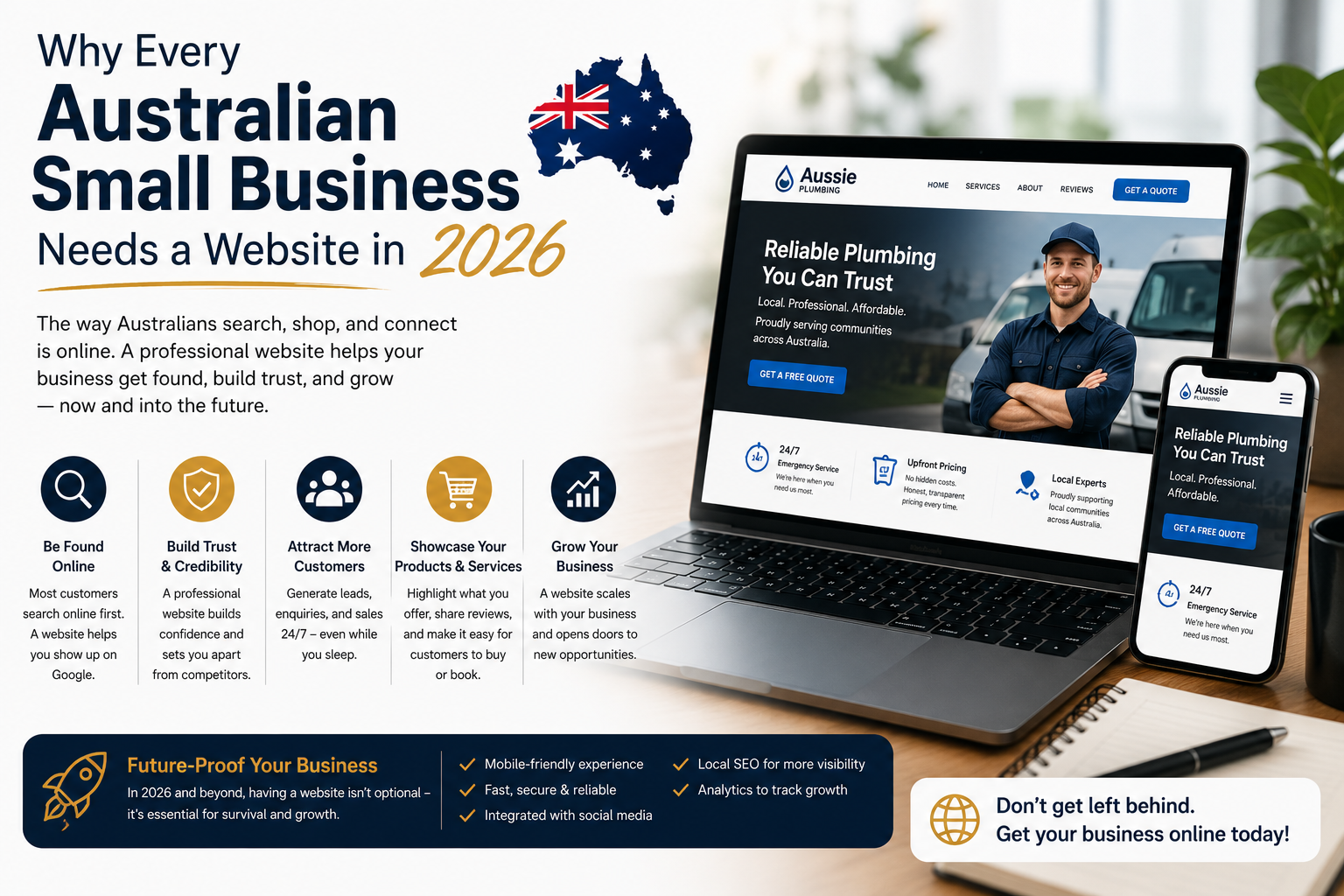
Still on the fence about getting a website? Discover why Australian small businesses without one are losing customers, revenue, and trust in 2026.
Here's a statistic that should stop every Australian business owner in their tracks: 97% of consumers search online before making a purchase decision, and businesses without a website are invisible in that moment. If your potential customer can't find you on Google when they're ready to buy, they'll find your competitor instead — and that's a transaction you'll never know you lost.
The Australian Digital Landscape in 2026
Australia has one of the highest internet penetration rates in the world. Over 21 million Australians are active internet users, and mobile internet usage has overtaken desktop across every major age group. In practical terms, this means your next customer is almost certainly holding a smartphone right now — and if your business doesn't appear when they search, you simply don't exist in their world.
The pandemic fundamentally shifted Australian consumer behaviour. Even industries that previously relied entirely on foot traffic — tradies, local cafes, GP clinics, boutique retailers — discovered that customers now research online before they walk through the door. That shift hasn't reversed. It's accelerated.
What a Website Actually Does for Your Business
Many small business owners think of a website as a digital business card — something nice to have but not essential. That's a significant misunderstanding of what a modern website does:
- It generates leads 24/7. Your website works while you sleep, on weekends, and on public holidays. A customer in Perth can enquire at 11pm and have your contact form reply waiting for them in their inbox by morning.
- It builds credibility before you've said a word. When someone is choosing between two plumbers and one has a professional website with reviews and photos and the other has nothing — the choice is made before a single phone call.
- It makes you discoverable on Google. A Google Business Profile helps, but it works far better when it links to a real website with real content. Google rewards businesses that provide detailed, useful information to searchers.
- It reduces the time you spend answering repetitive questions. FAQs, pricing guides, service descriptions, and booking forms on your website handle enquiries you'd otherwise need to manage personally.
The Cost of Not Having a Website
This is the calculation most business owners never do. Let's say you're a sparky in Sydney's western suburbs. If 10 potential customers per month find a competitor online instead of you because you have no web presence, and each job is worth $600 on average — that's $6,000 per month, or $72,000 per year in potential revenue walking straight to someone else. A quality website costs between $3,000–$8,000 AUD to build. The maths are not complicated.
The hidden costs extend beyond direct revenue loss:
- Trust deficit: Studies consistently show that 75% of consumers judge a business's credibility based on its website design. No website often reads as "not serious."
- Referral friction: When someone refers your business and the referred person can't find you online to verify you're legitimate, referrals convert at a much lower rate.
- Competitive disadvantage: Your competitors who do have websites are collecting the customers you're missing. They're building reviews, domain authority, and name recognition while you're standing still.
Social Media Is Not a Website Substitute
This is the most common objection: "I've got a Facebook page and an Instagram account — isn't that enough?" The honest answer is no, and here's why:
- You don't own your social media presence. Facebook can change its algorithm, restrict your reach, or suspend your account. It has happened to thousands of Australian businesses. Your website, on your own domain, is yours.
- Social media platforms don't rank well for service-based searches. When someone searches "accountant Ballarat," they're not looking for a Facebook page — they're looking for a website with services, credentials, and contact details.
- The professional credibility that comes from a well-designed website cannot be replicated by social media profiles. They serve different purposes — social media builds community, websites build credibility and capture intent-driven traffic.
Mobile Search and Google: How It Actually Works
Google's algorithm has been mobile-first since 2019, meaning it primarily uses the mobile version of your website to determine rankings. If your site isn't optimised for mobile, you're penalised in search rankings — full stop. In Australia, where over 68% of web browsing happens on mobile devices, a site that doesn't work beautifully on a phone isn't just inconvenient; it's a direct revenue leak.
Google also factors in page speed. A site that takes more than three seconds to load on mobile loses approximately 53% of visitors before they've seen a single word. Modern web design must prioritise performance, not just aesthetics.
Trust Signals That Websites Provide
Australian consumers have become sophisticated online researchers. Before choosing any service provider, many will look for:
- An ABN displayed or referenced on the website
- Genuine customer reviews and testimonials
- Photos of the team or premises
- Clear, transparent pricing or at least pricing ranges
- A physical address (even for home-based businesses, a suburb and phone number matter)
- Industry certifications, licences, or professional memberships
- An HTTPS secure connection (the padlock icon in the browser bar)
A well-designed website is the place to display all of these signals in a way that builds immediate confidence.
What About Free Tools Like Google Business Profile?
Google Business Profile (formerly Google My Business) is a genuinely powerful free tool that every Australian business should use — but it performs significantly better when it links to a proper website. Google's own documentation confirms that businesses with websites rank higher in local search than those without. Your GBP listing and your website work together; one without the other is leaving opportunities on the table.
Industry-Specific Realities
If you're in any of these industries, the urgency of having a website in 2026 is even higher:
- Tradies (plumbers, electricians, builders): Airtasker and Hipages take a cut of every job. Your own website generates leads with no commission.
- Health and wellness: Patients research providers extensively before booking. A professional site with clear credentials is expected.
- Hospitality (cafes, restaurants): Google searches for dining out are at an all-time high. Without a website showing your menu and location, you're invisible to the most motivated searchers.
- Professional services (accountants, lawyers, consultants): Credibility is everything. No website signals a lack of seriousness to high-value clients.
Getting Started Doesn't Have to Be Overwhelming
The biggest barrier most small business owners face is not knowing where to start or worrying it'll be too expensive. The reality is that a focused, well-built five-page website — covering your services, about page, testimonials, and contact form — can transform your online presence for a realistic investment. The key is working with a designer who understands your market and your goals, not just someone who produces pretty pages.
If your business doesn't have a website yet, or if your existing site is holding you back rather than driving growth, reach out to Acroxcreation. We help Australian small businesses establish a professional online presence that actually brings in customers — built to perform, designed to convert, and priced for real businesses.