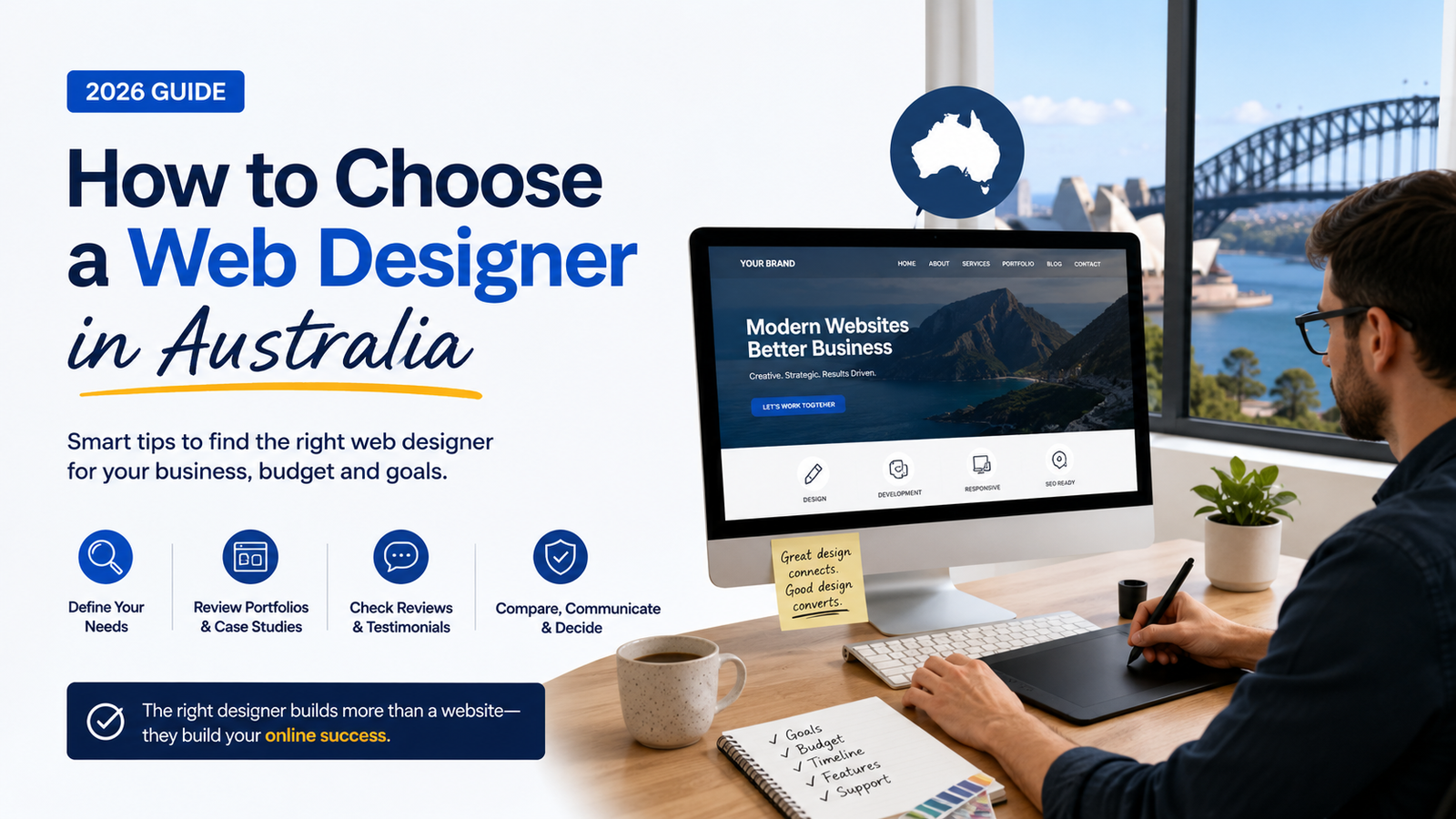
Looking to hire a web designer in Australia? Learn what to look for, red flags to avoid, questions to ask, and realistic AUD pricing expectations for 2026.
Hiring a web designer in Australia should feel exciting — not like navigating a minefield. Yet every week, Australian small business owners hand over thousands of dollars to designers who disappear mid-project, deliver a template dressed up as custom work, or produce something that looks great on a desktop but falls apart on a mobile phone. This guide will help you avoid every single one of those mistakes.
What Does a Web Designer Actually Do?
Before you hire anyone, it helps to understand what you're actually buying. A web designer handles the visual appearance and user experience of your site — layout, colours, fonts, imagery, and how visitors navigate from page to page. A web developer handles the technical build — the code that makes things function. Many agencies (and most freelancers) do both, but it's worth asking which skillset the person you're speaking with actually leads with.
In Australia, the lines blur constantly. A sole trader in Brisbane might call themselves a web designer but actually use Squarespace templates. A "digital agency" in Melbourne might subcontract your project offshore the moment you sign. Clarity upfront saves enormous grief later.
How Much Does a Website Cost in Australia?
Pricing varies wildly, and that's not inherently suspicious — it reflects scope. Here's a realistic breakdown for 2026:
- DIY platforms (Squarespace, Wix): $300–$800 per year in platform fees, plus your own time. Suitable for very early-stage businesses with minimal needs.
- Freelancer (basic 5-page site): $1,500–$4,000 AUD. Expect limited revision rounds and less strategic input.
- Small agency (custom WordPress or Webflow): $4,000–$12,000 AUD. Includes proper discovery, SEO foundations, mobile optimisation, and ongoing support options.
- Mid-to-large agency: $12,000–$50,000+ AUD. Full branding, custom functionality, e-commerce, integrations.
If someone quotes you $500 for a "complete professional website," ask hard questions. Somebody is absorbing a cost somewhere — usually quality, uniqueness, or your long-term ownership of the site.
Red Flags to Watch Out For
The Australian web design market is largely unregulated, which means anyone can call themselves a designer. Here's what should make you pause:
- No portfolio or vague portfolio: If a designer can't show you at least five live sites they've built, walk away. Links should open. The sites should be real businesses.
- They own your domain or hosting: You should own your own domain name (registered through Crazy Domains, GoDaddy, or similar) and have direct access to your hosting account. Designers who insist on holding these have significant leverage over you.
- No contract: A written agreement covering scope, timelines, payment milestones, and who owns the finished code is non-negotiable.
- Guaranteed Google rankings: No ethical designer or SEO can guarantee first-page rankings. Anyone who promises this is either lying or will use tactics that get your site penalised.
- No mention of mobile: Over 68% of Australian web traffic comes from mobile devices. If mobile isn't central to the conversation from day one, the designer is behind the times.
- Slow communication before you've signed: If they take three days to return an enquiry, imagine how responsive they'll be when you need a revision at 4pm on a Friday.
Questions to Ask Before You Hire
A good designer won't be offended by direct questions. Here's a practical list:
- Can you show me five live websites you've built in the last 18 months?
- Who will actually be doing the work — you, a team member, or an offshore contractor?
- Will I own the website code and all files when the project is complete?
- What platform will you build on, and why is that the right choice for my business?
- What does your revision process look like — how many rounds are included?
- What happens after launch — do you offer maintenance plans?
- How do you handle SEO during the build?
- What's your payment structure? (Typically 50% upfront, 50% on launch is fair.)
Local vs Offshore: What's the Real Difference?
Many Australian businesses are now working with designers based in India, the Philippines, or Eastern Europe — and getting genuinely excellent results. The key isn't geography; it's communication, accountability, and output quality. What matters is:
- Are they responsive during your business hours?
- Is their English clear and professional in writing?
- Do they understand Australian business context — GST display, .com.au domains, Australian Privacy Principles, payment gateways like Afterpay?
- Do they have testimonials from Australian clients?
The best offshore partnerships combine lower cost with high skill — but you still need to vet them as rigorously as any local hire.
What to Look for in a Portfolio
Don't just look at whether sites are pretty. Ask yourself:
- Do these sites load quickly? (Use Google PageSpeed Insights to check any URL.)
- Do they work properly on a mobile phone?
- Is the navigation intuitive — could you find the contact page in under 10 seconds?
- Do the sites reflect different industries and styles, or does every project look identical?
A strong portfolio shows versatility. A designer who can only produce one aesthetic will try to fit your business into their template, not the other way around.
Platform Matters More Than You Think
WordPress powers around 43% of all websites globally and remains the most flexible option for Australian small businesses — especially if you want to grow, add e-commerce, or manage content yourself. Webflow is excellent for design-led projects. Shopify is the go-to for e-commerce. Squarespace and Wix are fine for very simple brochure sites but become limiting fast.
Ask your designer to explain why they're recommending a specific platform for your needs — and be cautious of anyone who only knows one tool.
SEO and Website Design: They're Not Separate
A beautiful website that nobody can find is just an expensive digital brochure. From day one, your designer should be thinking about:
- Page load speed (Core Web Vitals)
- Mobile-first design and responsive layouts
- Clean URL structures
- Title tags and meta descriptions for every page
- Image compression and alt text
- Google Search Console setup and sitemap submission
These aren't "add-ons" — they should be baked into every professional build from the start.
Get It in Writing
Your contract should specify: the exact pages being built, the platform, delivery timeline with milestones, number of revision rounds, who provides copy and images, the payment schedule, what happens if either party terminates early, and who owns everything at the end. If a designer resists putting things in writing, that tells you everything you need to know.
Choosing the right web designer is one of the most important decisions you'll make for your business's online presence. If you're an Australian small business looking for a team that understands the local market, communicates clearly, and delivers results — get in touch with Acroxcreation today. We specialise in building high-performance websites for Australian businesses and would love to help you get it right the first time.