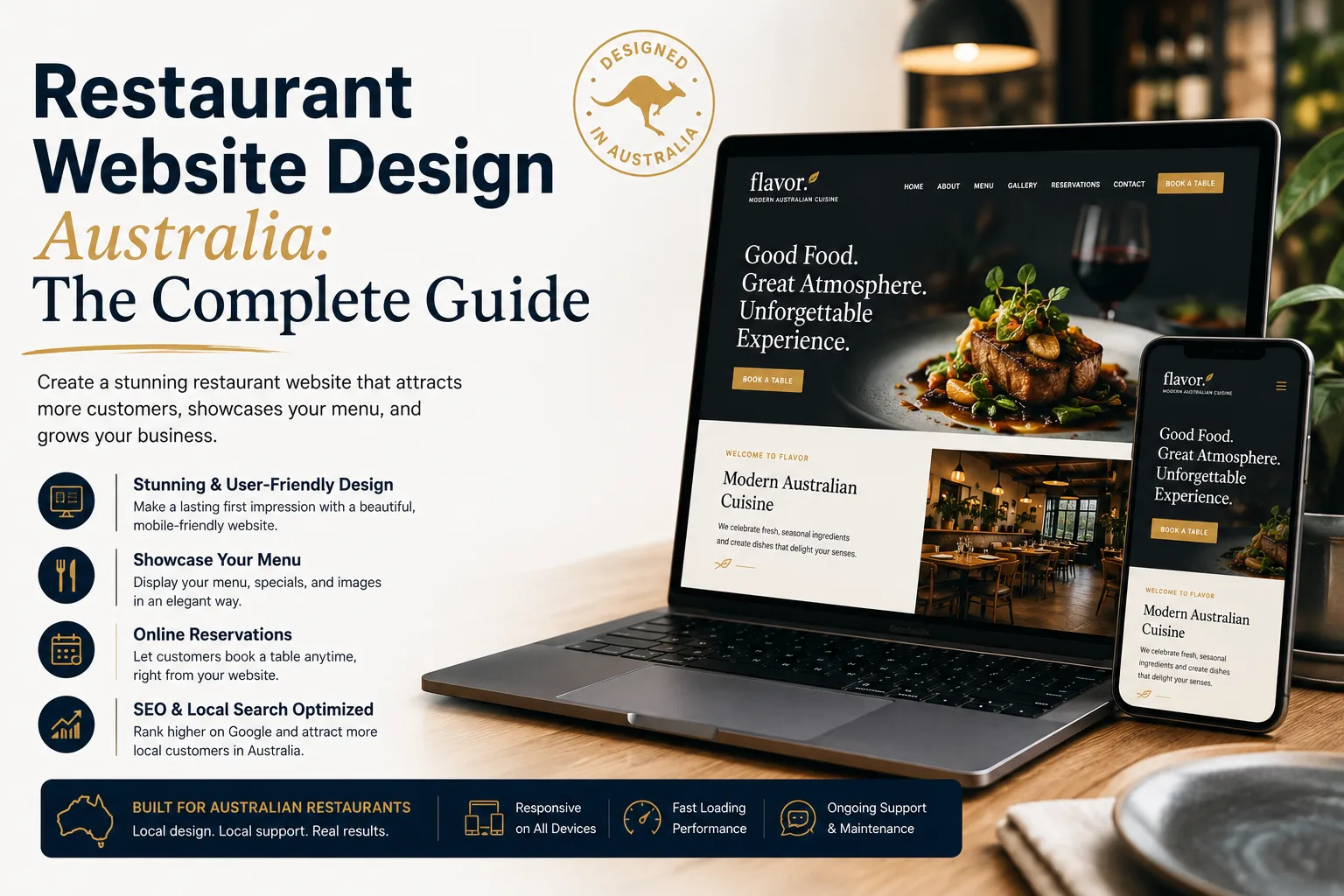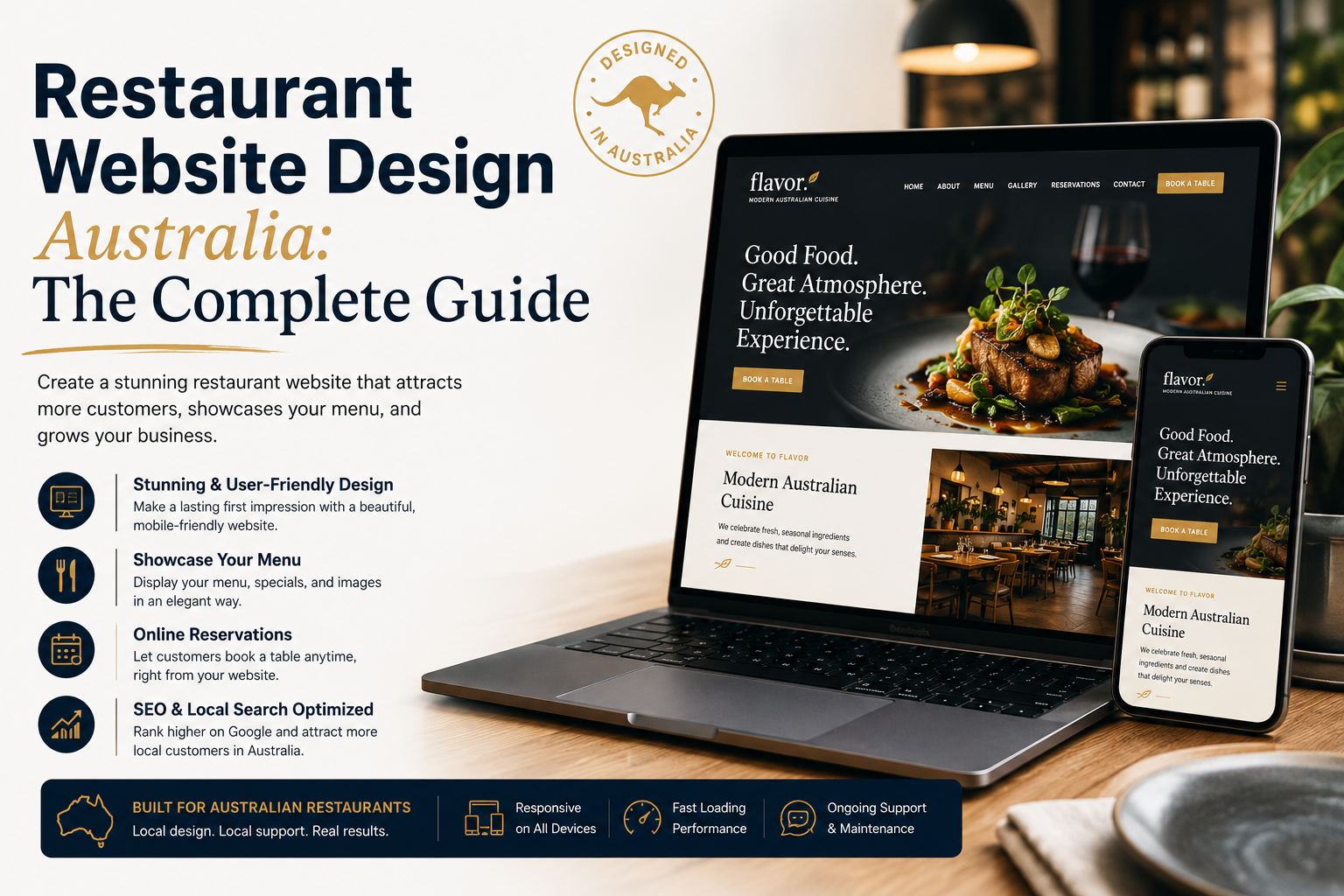
Everything Australian restaurants and cafes need in a website: online ordering, Google Maps, menus, booking systems, and local SEO that fills seats.
A hungry person in your suburb just typed "best Thai restaurant near me" into Google. In the next 30 seconds, they'll click the first result that shows them a menu they like, confirms they're open, and makes booking easy. If your restaurant's website doesn't deliver all three of those things instantly — on a mobile screen, without friction — that customer is sitting in someone else's dining room tonight.
What Australian Diners Expect From a Restaurant Website
Australian dining culture is vibrant, competitive, and increasingly digital. From the laneway cafes of Melbourne to the waterfront restaurants of Sydney's eastern suburbs and the hidden gems in Brisbane's West End, the hospitality sector has one of the highest concentrations of online search activity of any industry. The expectations are clear:
- A menu that's easy to read on a mobile phone
- Opening hours that are accurate and up to date
- A location map that integrates with Google Maps or Apple Maps
- A way to book a table without needing to call
- Photos of actual food — not stock images
- Reviews from real customers
These aren't nice-to-haves. They're table stakes. A restaurant website that's missing any of these is losing bookings every single day.
Online Ordering: Now Essential, Not Optional
The pandemic accelerated Australia's shift to online food ordering at an extraordinary pace, and that behaviour is permanent. DoorDash, Uber Eats, and Menulog generate enormous volume — but they also take commissions of 15–35% on every order. For restaurants operating on thin margins, that's devastating at scale.
The smartest restaurant operators in Australia are now using their own website to capture direct orders. Platforms like me&u, Bopple, and OrderMate allow restaurants to embed a direct ordering system on their website — zero commission, full customer data, and the ability to build loyalty. Even a small restaurant doing $15,000 per week in delivery orders saves $2,250–$5,250 per week by shifting 30% of orders to direct channels.
When building your restaurant website, prioritise an online ordering integration that:
- Works seamlessly on mobile
- Syncs with your kitchen POS system
- Allows customers to schedule orders in advance
- Captures emails for future marketing
Google Maps Integration and Local SEO
The vast majority of restaurant discoveries happen through Google Search and Google Maps. When someone searches "breakfast cafe Fitzroy" or "Italian restaurant Gold Coast," Google pulls results based on a combination of your Google Business Profile, your website, and proximity to the searcher.
To maximise local search visibility, your restaurant website needs:
- Consistent NAP: Your Name, Address, and Phone number must be identical across your website, Google Business Profile, Facebook page, and any listing sites like Zomato or Broadsheet.
- LocalBusiness schema markup: This is structured data in your website's code that tells Google exactly what type of business you are, your hours, your cuisine type, and your location. It directly influences how your listing appears in search results.
- Suburb-specific content: If your restaurant is in Surry Hills, use "Surry Hills" naturally throughout your site content — in your about page, your footer, and any neighbourhood-specific context.
- Embedded Google Maps: An embedded map on your contact or location page is a genuine local SEO signal, not just a convenience feature.
Menu Design for the Web
This is where many Australian restaurants make a critical mistake: uploading their menu as a PDF. PDF menus are problematic for several reasons:
- They're difficult to read on mobile screens
- They can't be indexed by Google (meaning the items on your menu don't help you rank for food-related searches)
- They don't update dynamically — every seasonal change requires a new upload
- They load slowly and often require a separate app to open
The solution is an HTML-based menu built directly into your website. Organised by category, with prices clearly listed, dietary information flagged (GF, vegan, dairy-free — increasingly important to Australian diners), and updated in real time. Some restaurants use a menu management plugin that allows staff to update items directly from a simple admin panel.
Booking System Integration
Australians increasingly prefer to book online rather than call. A frictionless booking experience can meaningfully increase your covers. Popular booking platforms used by Australian restaurants include:
- ResDiary: Widely used across Australia, integrates with POS systems and Google Reserve
- Nowait / Yelp Waitlist
- Quandoo: Strong presence in major Australian cities
- OpenTable: Premium restaurants and hotels
Whichever system you choose, the integration on your website should allow booking directly from your homepage — not hidden three clicks deep. A "Book a Table" button should be visible in your navigation on both desktop and mobile.
Photography: The Highest ROI Investment You Can Make
Professional food photography is not a luxury for Australian restaurants — it's the most powerful conversion tool your website has. Research shows that restaurants with high-quality food images receive up to 70% more enquiries than those without. The investment in a three-hour food photography session (typically $800–$2,000 AUD with a good local food photographer) will be recovered in new bookings within weeks for most active restaurants.
Your website needs:
- Hero images of your signature dishes
- Ambience shots of your dining room during service
- Images of your team
- Exterior photography for Google Business Profile
Building Trust Through Reviews
Australian diners trust peer reviews heavily. Displaying Google reviews or Tripadvisor ratings on your website builds immediate confidence. Tools like Elfsight or ReviewsWidget allow you to embed live Google review feeds directly into your site. A visible average rating of 4.5+ stars on your homepage is one of the most powerful conversion elements you can add.
Additionally, every restaurant website should include a strategy for actively requesting reviews from satisfied customers — whether through a QR code on the table, a follow-up SMS, or a card with the bill.
Mobile Performance: Non-Negotiable
A restaurant website that doesn't work perfectly on a smartphone is losing reservations in real time. Mobile-first design means:
- Tap-to-call phone numbers
- Tap-to-navigate address integration with Google Maps
- Fast-loading images (compressed without quality loss)
- Large, easy-to-tap buttons for booking and ordering
- A menu that scrolls smoothly without requiring pinch-and-zoom
Social Media Integration
For restaurants, Instagram is a powerful discovery channel. Your website should link clearly to your Instagram, and your most recent posts can be embedded on the homepage to show fresh, real content. This social proof — real photos from real meals, regularly updated — builds trust in a way that static designed pages cannot.
Running a restaurant in Australia is already hard enough without your website working against you. If you're ready for a site that fills tables, handles bookings, and makes your food look as good as it tastes, contact Acroxcreation. We build restaurant websites that are as functional as they are beautiful — and we understand the Australian hospitality market inside and out.