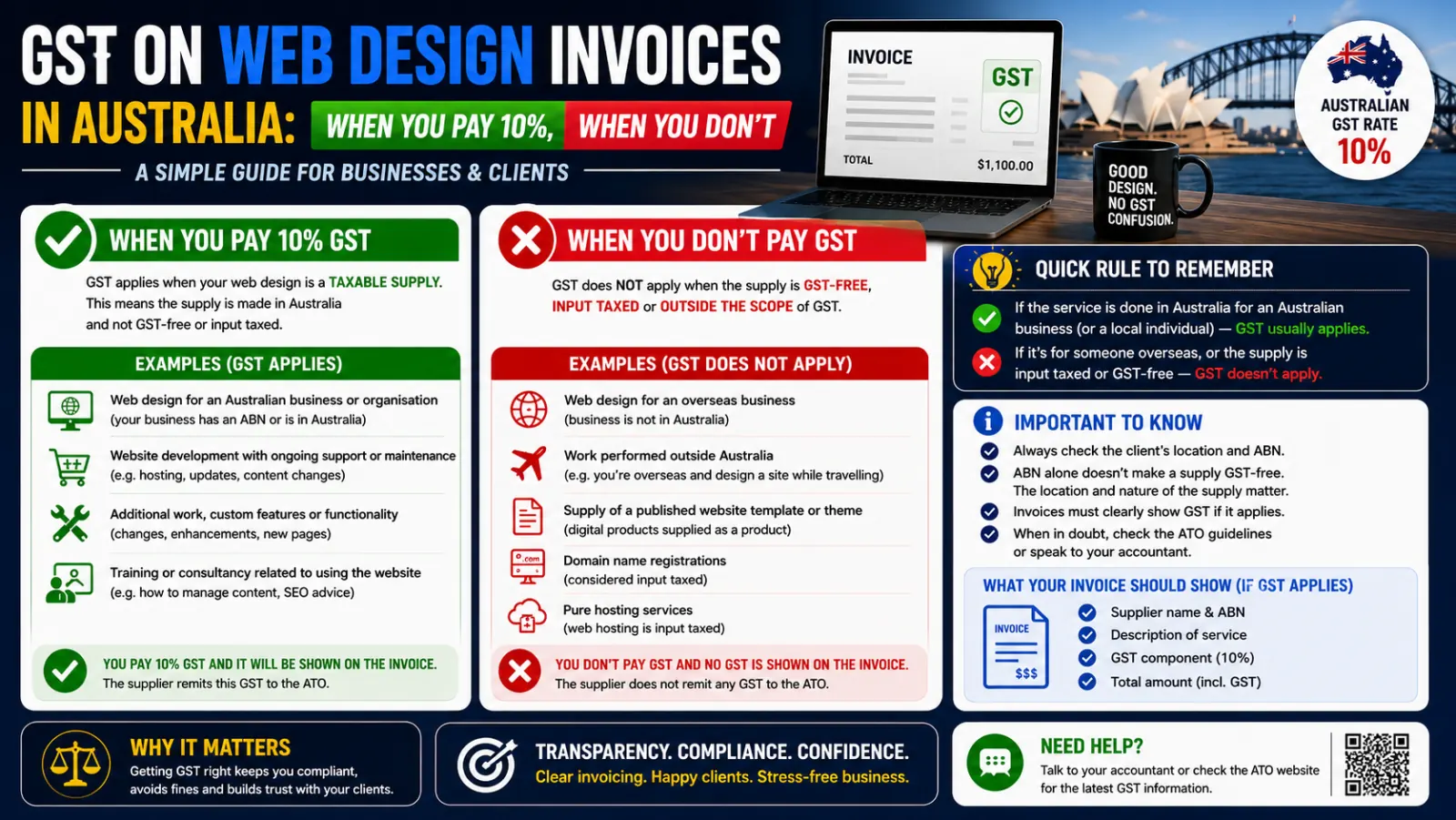
Plain-English guide to GST on web design and branding invoices in Australia in 2026, when it applies, when it's zero-rated, and how AU businesses legally save 10% by hiring LUT-registered offshore designers.
The most common question we get from Australian small business clients isn't about design, it's about GST. "Do I add 10%?" "Can I claim it back?" "What if the designer is overseas?" Here's the plain-English version, current to 2026, including the legal way AU businesses save 10% on design work.
When you (the AU client) pay GST
If your design or development supplier is registered for Australian GST (mandatory for agencies turning over $75,000+/year), they must add 10% on top of every invoice. That covers:
- Web design and development services
- Logo and branding work
- SEO retainers and ad management fees
- Hosting they on-bill to you
- Stock photography or third-party tools they on-charge
Their tax invoice must show: their ABN, the words "Tax Invoice", the GST-exclusive amount, the GST amount, the GST-inclusive total, the date, and a description of the supply. If any of those are missing, you legally cannot claim it back through your BAS.
When GST does NOT apply
1. Your supplier is overseas (non-resident). Australia only taxes supplies that are connected with Australia. A designer based in India, the Philippines, or the UK who has no Australian establishment and is supplying services consumed by an Australian business is generally outside the AU GST net. You don't pay 10% GST to them, and they don't collect it.
2. The overseas supplier is LUT-registered in their home country. This is the part most AU buyers don't know. In India, exporters of services can file a Letter of Undertaking (LUT) with the GST department. Once approved, every service invoice they raise to a non-Indian client is zero-rated, no Indian GST charged either. The AUD figure on the invoice is the entire amount you transfer. No hidden tax layer on either side of the border.
This is fully legal under both Australian and Indian tax law. It's the same mechanism that makes outsourcing accounting, dev work, and back-office services to India cost-competitive for Western businesses.
3. The supplier isn't GST-registered at all. A sole-trader designer doing $40k/year (under the $75k AU threshold) cannot legally charge "$X + GST". If they do, ask for their ABN, if it's not flagged as GST-registered on ABN Lookup, the GST line is invalid and you don't pay it.
The 10% maths, side by side
Say you need a $3,500 small business website. Three providers quote you:
- Sydney agency, GST-registered: $3,500 + 10% GST = $3,850 total. You can claim the $350 GST back through BAS if you're GST-registered yourself. If you're a sole trader under $75k, you can't, it's a real $350 cost.
- Indian studio, LUT-registered (e.g. us): $3,500 AUD, zero-rated. $3,500 total hits your card. No 10%, no input credit needed, no BAS reconciliation.
- Random freelancer with no ABN: $3,500. No tax invoice. You can't claim anything, and if you're audited, the deduction can be questioned. Risky.
For most AU small businesses, that means a properly-set-up offshore studio comes in at 9–10% lower net cost than a comparable domestic agency, with the same protections (real invoice, real ABN/PAN, written scope, IP transfer clauses) if you pick a credible provider.
What to ask before you hire offshore
- Are you registered for GST in your home country? A "yes" with a registration number you can verify is a baseline trust signal.
- Do you operate under an LUT for export of services? If yes, your invoice will be zero-rated and the AUD amount is final.
- Will the invoice show your business details + the export classification? You need this for your own bookkeeping and to substantiate the foreign supply on your BAS as a non-creditable import.
- How do I pay you in AUD? Direct AUD bank transfer (via Wise, OFX, or your bank's international service) avoids visible-FX markups. Stripe is also fine but the platform takes ~2.9%.
If you're the supplier (not the buyer)
For Aussie agencies / freelancers: if you're GST-registered, charge 10% on every domestic invoice, lodge BAS quarterly (28th of month after quarter end), and claim input credits on Adobe CC, hosting, contractor invoices, etc. If you bill overseas clients (UK, US, NZ), those supplies are GST-free exports, record on BAS but don't charge GST.
None of this is legal or accounting advice, talk to your bookkeeper or accountant for your specific setup. But these are the questions we wish someone had answered for us in year one. For pricing without GST surprises, see our transparent AUD package list, every package is LUT-export priced, no GST line, no FX markup.