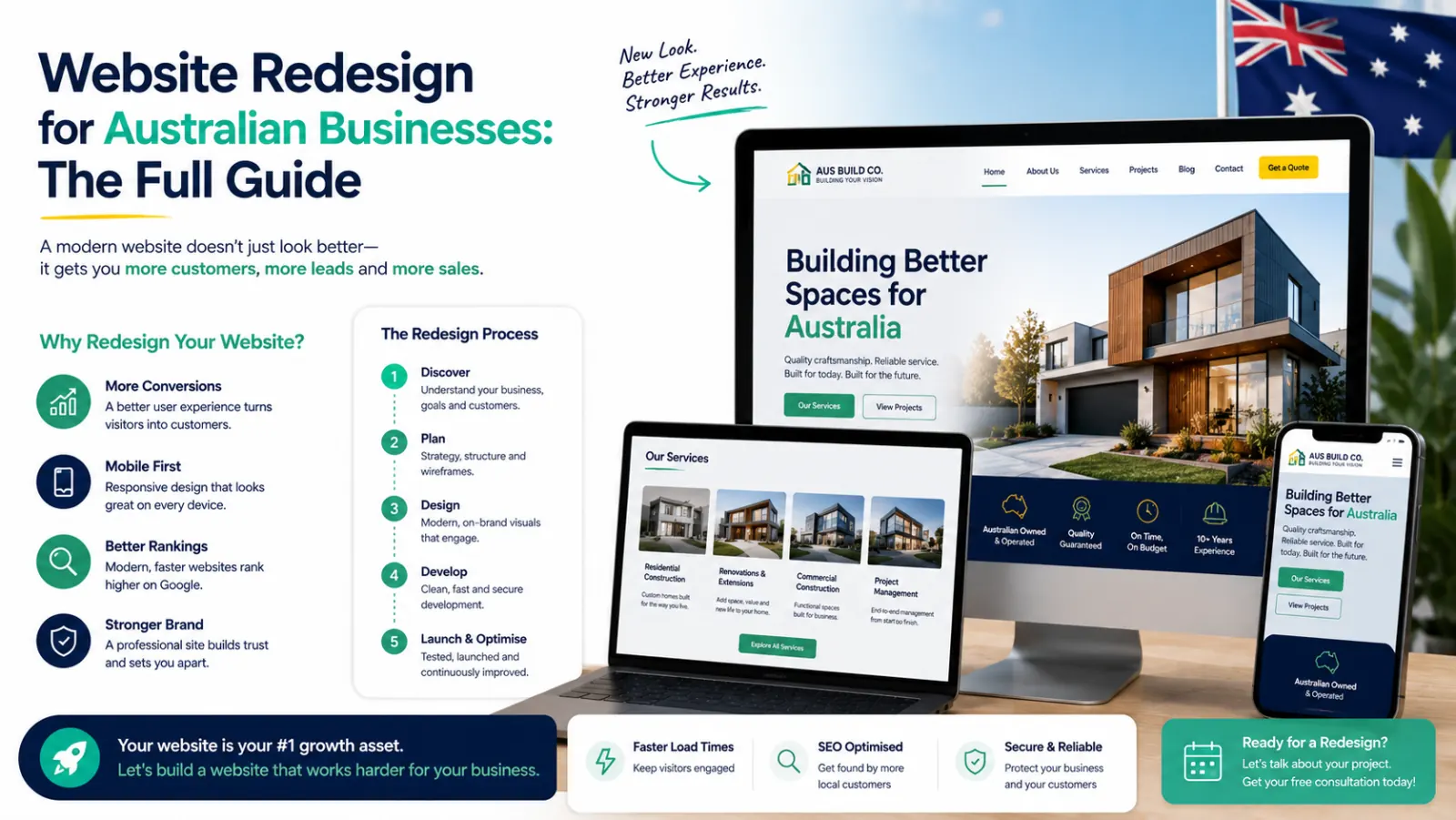
Is your Australian business website overdue for a redesign? Learn the warning signs, what to keep vs rebuild, how to protect your SEO, and realistic costs.
Your website is often the first impression a potential customer has of your business. If that impression is outdated, slow, confusing, or unprofessional, you're actively losing business every day your old site stays live. For many Australian businesses, a website redesign isn't just an aesthetic upgrade, it's a commercial necessity. But it also carries risks if done carelessly, particularly around SEO. This guide covers everything you need to know.
Signs Your Australian Business Website Needs a Redesign
Not every underperforming website needs to be rebuilt from scratch, but these are the clearest signals that your current site is actively working against you:
- It was built more than four years ago: Web standards, mobile expectations, and SEO requirements have changed dramatically. A 2020-era site often fails modern performance benchmarks.
- It's not mobile-friendly: If your site requires pinching and zooming on a phone, you're losing more than half your visitors before they read a single word.
- It loads slowly: Google's Core Web Vitals benchmarks are now ranking factors. A site that takes more than three seconds to load on mobile is penalised in search results.
- You're embarrassed to share it: If you hesitate before handing your URL to a potential client, that hesitation has a dollar value attached to it.
- You can't update it yourself: A website that requires a developer every time you need to change a phone number or upload a photo creates unnecessary cost and delay.
- Your conversion rate is low: If traffic is reasonable but enquiries are minimal, the problem is usually the site, not your marketing spend.
- It doesn't reflect your current brand: Businesses evolve. A site that represents who you were three years ago rather than who you are today creates a disconnect with the customers you're now trying to attract.
- Competitors have overtaken you online: If a direct competitor recently relaunched their site and you've noticed a drop in enquiries, the correlation is likely real.
What to Keep in a Redesign
A redesign doesn't mean starting from zero. Careful analysis of your existing site often reveals assets worth preserving:
- High-performing content: Blog posts or pages that generate consistent organic traffic should be preserved, enhanced, and redirected carefully, never simply deleted.
- Existing backlinks: If other websites link to specific pages on your site, those links have SEO value. Changing those URLs without proper redirects wastes that value permanently.
- Customer testimonials and reviews: Social proof is valuable. Migrate testimonials to the new site, ideally in a format that's more prominent and visually compelling than before.
- Brand equity elements: Your logo, established colour palette, and brand voice should evolve, not disappear. Radical reinvention confuses existing customers.
What to Rebuild
Some elements of an old site are genuinely worth discarding:
- Outdated page structures that don't reflect how customers actually search for your services
- Generic stock photography that creates no emotional connection
- Old contact forms without automation or CRM integration
- PDF menus, brochures, or downloadable content that's no longer accurate
- Navigation structures that made sense in 2018 but no longer reflect your service offering
- Any plugin or functionality that's been abandoned by its developer and no longer receives security updates
The SEO Impact of a Redesign, and How to Protect It
This is where many Australian business owners get a nasty shock six months after launching their shiny new site: traffic has dropped significantly. The culprit is almost always poor handling of SEO during the redesign. Here's how to protect your rankings:
301 Redirects Are Non-Negotiable
Every URL that changes during a redesign needs a 301 redirect pointing from the old address to the new one. This preserves link equity and ensures anyone who bookmarked or shared an old link still arrives somewhere relevant. Missing redirects are the single most common cause of post-redesign traffic drops.
Preserve Your Title Tags and Meta Descriptions
Your existing meta data often reflects months or years of optimisation. Don't reset it without reviewing what was working. Export your current metadata before the redesign begins and use it as a baseline for the new site.
Don't Change Your URL Structure Without Reason
If your current URLs are sensible and working, don't change them. URL restructuring is sometimes necessary, but it should be deliberate and accompanied by comprehensive redirects, not a casual consequence of switching platforms.
Test Before Launch
Use a staging environment to run a full technical SEO audit before the new site goes live. Check for crawl errors, broken internal links, missing canonical tags, and mobile usability issues. Launching and then fixing is far more disruptive than fixing before launch.
Submit a Fresh Sitemap
As soon as the new site launches, submit an updated XML sitemap to Google Search Console. This accelerates re-crawling and reduces the window of ranking uncertainty.
Redesign vs Refresh: Know the Difference
Not every underperforming website requires a full rebuild. Sometimes a targeted refresh achieves most of the benefits at a fraction of the cost:
- Refresh: Updated typography, improved colour palette, new photography, faster hosting, minor structural improvements. Suitable if the underlying platform and content are sound. Cost: $1,500–$3,500 AUD.
- Redesign: New design system, new page structure, potentially new platform, new content strategy. Required when the current site is fundamentally misaligned with your business goals. Cost: $4,000–$15,000 AUD depending on size and complexity.
What Does a Website Redesign Cost in Australia?
Realistic 2026 pricing for Australian businesses:
- 5–10 page business site redesign: $4,000–$8,000 AUD
- 15–30 page content-rich site: $8,000–$18,000 AUD
- E-commerce redesign: $10,000–$30,000+ AUD
These ranges assume a professional agency or experienced freelancer and include discovery, design, development, content migration, SEO preservation, and launch. Cheaper options exist but typically involve templates, limited revisions, and no strategic input.
Choosing the Right Time to Redesign
Timing matters. For most Australian businesses, launching a new site during a quieter trading period reduces risk. Avoid launching immediately before a major sales event or peak season, give the new site two to four weeks to stabilise in search rankings before you need it to perform at its highest. The week after the Australia Day long weekend, or early in the financial year (July–August) are often sensible windows for many industries.
Working With Your Designer on a Redesign
Provide your redesign partner with Google Analytics access, Google Search Console data, and a list of your most important pages (measured by traffic, not just which ones you personally value). This data drives strategic decisions that a pure design brief cannot. The best redesigns are informed by evidence, not just creative preference.
If your current website is holding your business back, it's time for an honest conversation about what needs to change. Contact Acroxcreation today for a no-obligation review of your existing site. We'll tell you what's working, what isn't, and the most efficient path to a website that actually performs for your Australian business.