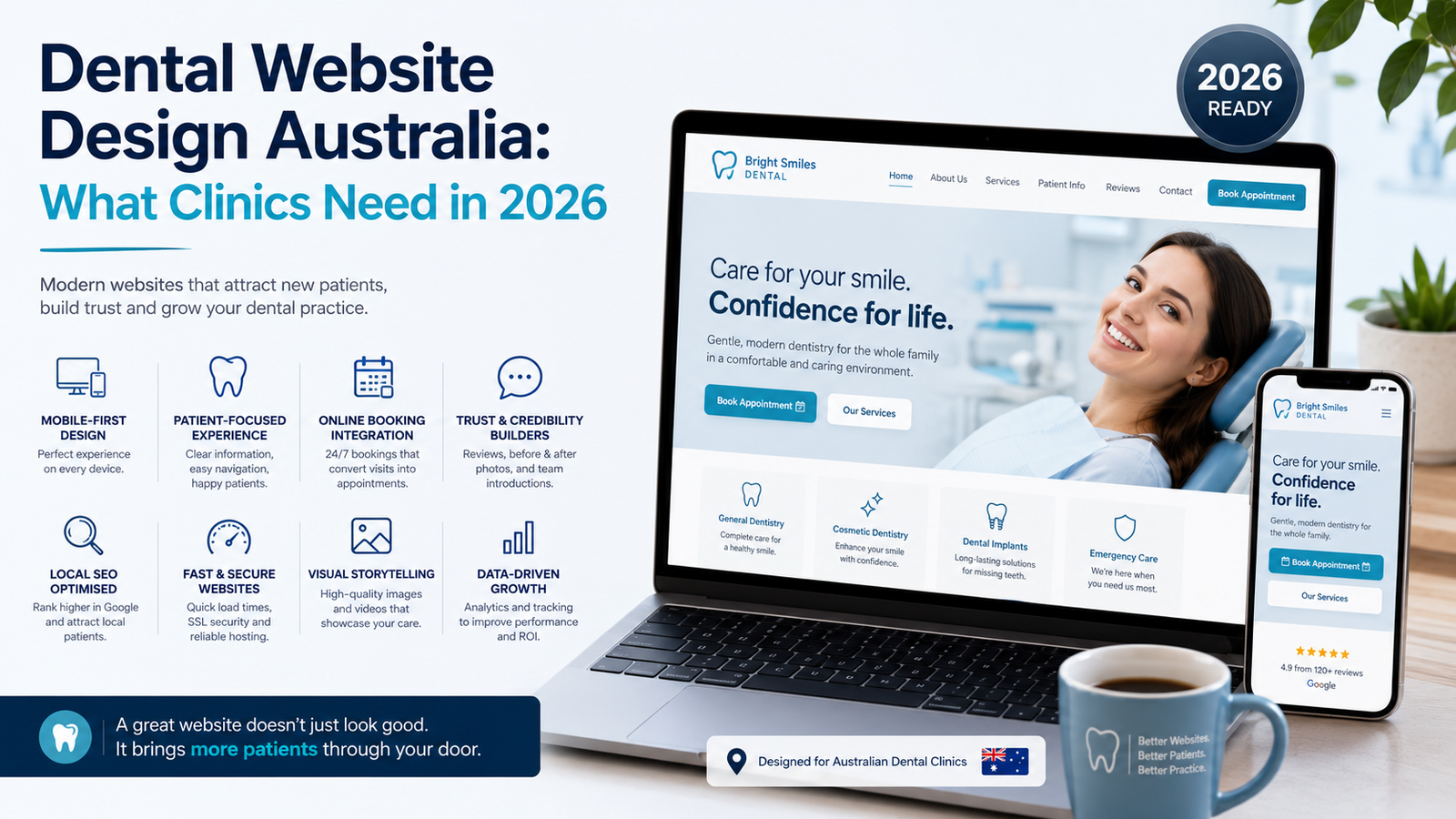
A complete guide to dental and medical clinic website design in Australia — AHPRA compliance, online booking, patient trust signals, and local SEO for clinics.
A patient in your suburb just searched "dentist near me" on their phone. In the next 90 seconds, they'll assess two or three dental websites, choose the one that feels most trustworthy and easiest to book through, and either make an appointment or move on. In a sector where patient acquisition cost is high and lifetime patient value is significant, your website is the front door to your entire practice — and in 2026, it needs to be working harder than ever.
The Unique Challenges of Healthcare Website Design in Australia
Designing a website for a dental practice or medical clinic in Australia isn't like designing for a retail business. You're operating in a regulated professional environment with specific advertising rules, patient privacy obligations, and trust requirements that go well beyond what most industries face. Get the design right and you fill your appointment book. Get it wrong — legally or strategically — and the consequences are significant.
AHPRA Compliance: Non-Negotiable Requirements
The Australian Health Practitioner Regulation Agency (AHPRA) sets strict guidelines for how registered health practitioners can advertise their services. These guidelines apply to your website, your Google Business Profile, your social media, and any paid advertising.
The key restrictions every dental and medical website must observe:
- No testimonials or reviews that refer to a practitioner: This is the most commonly misunderstood rule. Under AHPRA's guidelines, publishing patient testimonials that mention a specific practitioner (e.g., "Dr Smith fixed my teeth beautifully") on your own website or advertising materials is prohibited. Note: you cannot control Google reviews, but you cannot reproduce them in your advertising.
- No misleading claims: Statements like "best dentist in Melbourne" or "most experienced oral surgeon in Queensland" are prohibited under AHPRA and Australian Consumer Law.
- No before-and-after photos in advertising: AHPRA prohibits using before-and-after photos of cosmetic procedures in advertising.
- No discounts that induce patients to choose treatment they don't clinically need.
- All claims must be substantiated: Any factual claims about services, outcomes, or qualifications must be able to be substantiated if challenged.
AHPRA conducts regular sweeps of healthcare practitioner websites. Non-compliance can result in formal investigations, fines, and reputational damage. Have your website content reviewed by someone familiar with AHPRA guidelines before launch.
Online Booking: The Single Biggest Conversion Driver
Patients increasingly expect to book dental appointments online — at any hour, without speaking to anyone. Practices that don't offer online booking are losing new patients to those that do. Popular booking platforms for Australian dental practices include:
- Cliniko: Widely used across Australian allied health and dental practices, excellent patient portal and online booking integration
- Dental4Windows: The dominant practice management software in Australian dentistry, with patient portal integration
- HotDoc: Primarily used by GP practices but expanding into dental; excellent for practices focused on maximising new patient acquisition
- PowerDiary: Suitable for smaller practices, clean patient-facing interface
The booking widget should appear prominently on every page of your site — not hidden in a "New Patients" tab that requires three clicks to reach.
Building Patient Trust Online
Dental anxiety affects approximately 16% of Australians, and even non-anxious patients are cautious about choosing a new dentist. Your website needs to do significant trust-building work before a new patient ever contacts you:
Team Pages That Humanise Your Practice
Professional photography of every dentist and key staff member, paired with genuine bios — university training, years of experience, areas of interest, and something personal (favourite weekend activities, what they love about dentistry). Patients choose practitioners they feel they can connect with. Generic team pages with CV-style text fail this test.
Clear Service Descriptions
Many patients don't know the difference between a scale and clean and a periodontal treatment, or what Invisalign involves versus traditional braces. Clear, jargon-free service pages that explain what a procedure involves, how long it takes, whether it hurts, and how much it typically costs (or a realistic range) answer the questions patients are afraid to ask and significantly reduce the barrier to booking.
Pricing Transparency
Australian dental pricing varies widely and many patients have anxiety about unexpected costs. Offering published pricing ranges — or at minimum, clearly explaining that a consultation includes a treatment plan with fees — reduces booking friction considerably. The health funds accepted by your practice should also be listed prominently.
Credentials and Memberships
Display your AHPRA registration number, Australian Dental Association membership, and any specialist qualifications. For orthodontists, periodontists, and oral surgeons, specialist registration details should be immediately visible.
Local SEO for Dental Practices
Dental practices serve patients within a relatively tight radius — typically 5–10 kilometres for general dentistry in metropolitan areas. Local search optimisation is therefore the highest-ROI digital marketing activity for most practices.
Key local SEO priorities:
- Google Business Profile: Your GBP listing is the dominant factor in whether you appear in the local "map pack" when patients search "dentist [suburb]." It must be complete, accurate, and regularly updated with photos and posts.
- Suburb-targeted landing pages: If you serve patients from multiple surrounding suburbs, a dedicated page for each major feeder suburb (e.g., "Dentist serving Bondi Junction") helps you rank for those suburb-specific searches.
- Patient reviews: Google reviews are a significant local ranking factor. Implement a systematic process for requesting reviews from satisfied patients — a follow-up SMS after an appointment with a direct review link converts well.
- Health directory listings: Ensure your practice is listed on HealthEngine, HotDoc, Whitecoat, and RateMyDentist with consistent NAP (name, address, phone number).
Website Speed and Mobile Performance
Healthcare patients research on mobile, often in moments of discomfort or urgency. A slow-loading dental website is disproportionately costly in this context. Aim for a Google PageSpeed Insights score above 80 for mobile, and ensure your booking button is large, visible, and functional on a small screen within two seconds of the page loading.
Privacy Policy and Australian Privacy Principles
Any website that collects personal health information — including booking forms that ask about existing conditions or health funds — must have a Privacy Policy that complies with the Australian Privacy Act 1988. For healthcare practices, this policy must also address how patient health records are stored and protected, consistent with the obligations under the Privacy Act and relevant state health records legislation.
Emergency Dental Content
A page specifically addressing dental emergencies — what constitutes an emergency, when to call your practice, what to do while waiting — captures high-intent searches ("emergency dentist Sydney," "broken tooth what to do") and directly converts distressed patients who need immediate help. This is both genuinely useful content and a significant local SEO opportunity.
Running a dental practice in Australia requires clinical excellence — your website should reflect that same commitment to quality. If you're ready for a website that's AHPRA-compliant, conversion-optimised, and built to rank in your local area, contact Acroxcreation. We understand the specific requirements of Australian healthcare websites and deliver results that fill appointment books.