Learn how to rank on Google Australia in 2026 — local SEO, Google Business Profile, content strategy, backlinks, and on-page optimisation for small businesses.
The first page of Google is the most valuable piece of commercial real estate in Australia — and unlike physical property, a small business in Geelong or Cairns or Hobart can compete directly with companies twenty times their size, if they understand how the game is played. This is not a vague guide about "creating great content." This is a practical, specific roadmap for ranking your Australian business on Google in 2026.
How Google Decides Who Ranks
Google's ranking algorithm considers over 200 signals, but for the vast majority of Australian small businesses, the decisive factors are a manageable set of fundamentals. Understanding these is more valuable than chasing every new algorithm update:
- Relevance: How well does your page match what the searcher is actually looking for?
- Authority: How much does the web trust your site, based on the quality and quantity of other sites linking to you?
- Technical health: Can Google crawl, understand, and render your website correctly?
- User experience: Does your site load fast, work on mobile, and keep visitors engaged?
- Local signals: For location-based searches, does Google have confidence that you serve the area being searched?
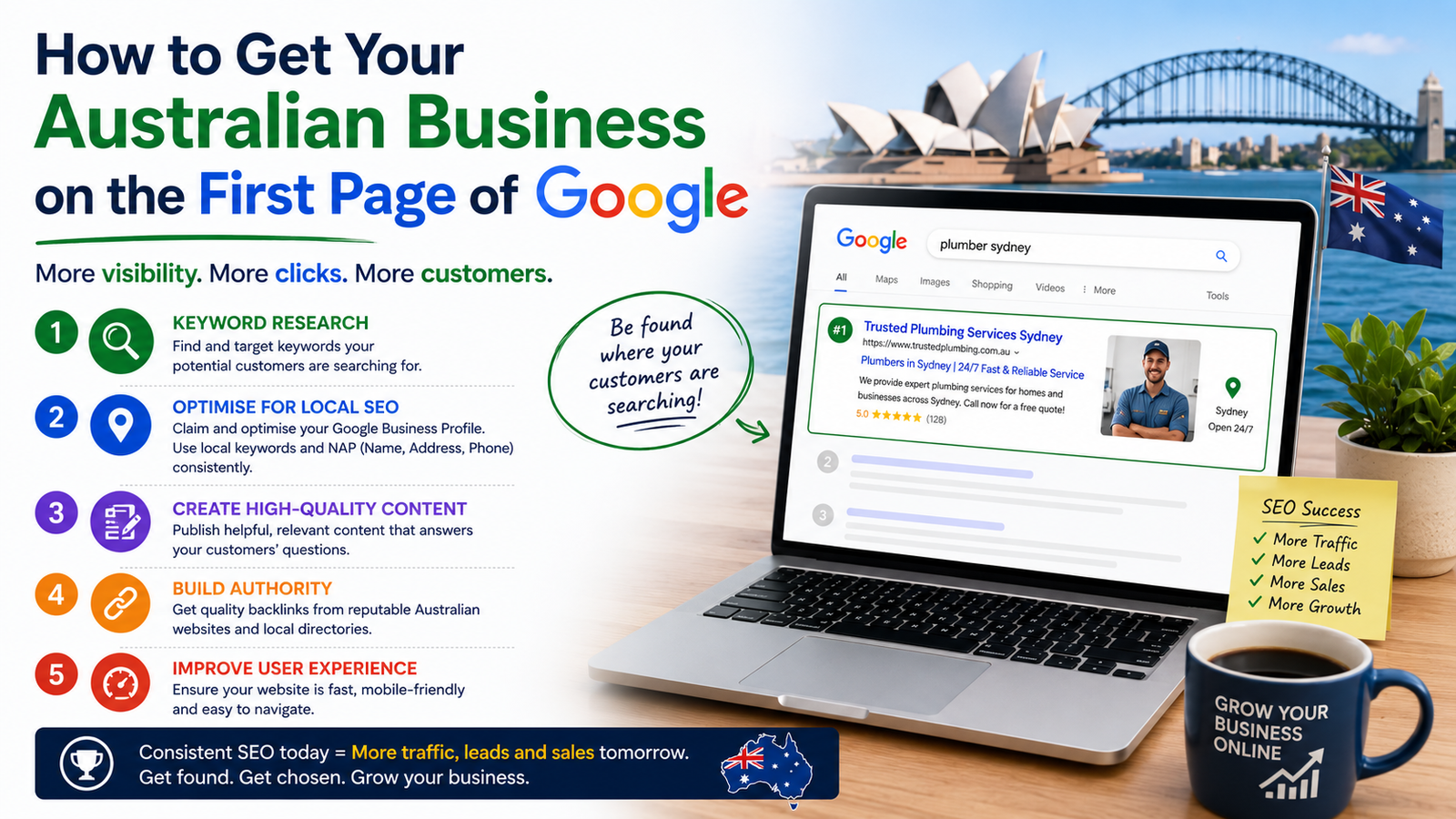
Start With Keyword Research: Know What Australians Actually Search
The biggest mistake Australian business owners make is trying to rank for terms they think sound important rather than terms their customers actually type. Keyword research grounds your strategy in reality.
Free tools to start with:
- Google Search (autocomplete and People Also Ask): Type your service + your city into Google and note what autocomplete suggests — that's real search data.
- Google Keyword Planner: Free with a Google Ads account, shows Australian search volume.
- Ubersuggest: Free tier shows keyword ideas and basic volume.
Key principles for Australian keyword research:
- Include suburb and city names — "accountant Brisbane northside" is more winnable and often more valuable than "accountant Brisbane"
- Target question-based searches — "how much does a bathroom renovation cost in Perth" has clear intent and relatively low competition
- Look for long-tail variations — three to five word phrases that are specific, lower competition, and highly intentional
Google Business Profile: Your Local Ranking Foundation
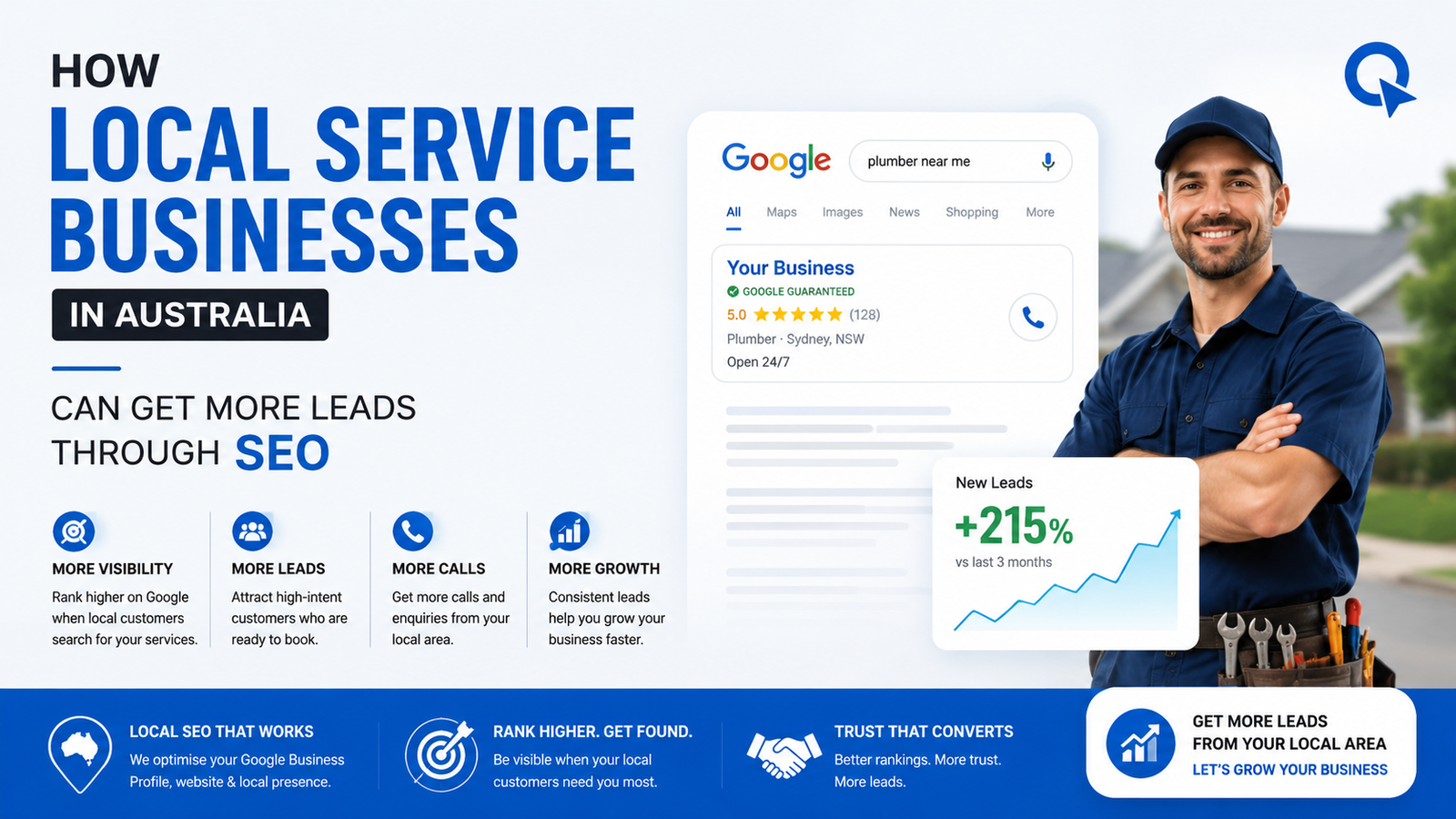
For any search with local intent — any search that includes a suburb name, a city, or words like "near me" — your Google Business Profile is the most important ranking factor. The Map Pack (three local results shown above organic results) is driven almost entirely by GBP signals, proximity, and reviews.
To maximise your local ranking:
- Verify and fully complete your GBP listing
- Choose the most accurate primary category
- Add photos regularly (once per week minimum)
- Accumulate genuine Google reviews consistently
- Respond to every review
- Post updates weekly using Google Posts
- Keep business hours accurate, including for Australian public holidays
A well-optimised GBP in a secondary city (Wollongong, Launceston, Bunbury, Toowoomba) can dominate local search within six to twelve weeks. Even in Sydney and Melbourne, consistent GBP management produces measurable ranking improvement.
On-Page SEO: Telling Google What Your Pages Are About
Every page on your website should be optimised for a specific keyword or topic. The key on-page elements are:
Title Tag
The clickable headline in Google Search results. Keep it under 60 characters, include your target keyword, and make it compelling. For local pages, include your suburb or city: "Carpet Cleaning Canberra | Spotless Home Services"
Meta Description
The two-line description below your title in search results. Doesn't directly influence rankings but significantly affects click-through rate. Write it like an advertisement — include your keyword and a specific benefit or call to action.
H1 Heading
The main heading on your page. Every page should have one H1, and it should include your target keyword naturally.
Page Content
Google assesses topical depth. A page targeting "conveyancer Melbourne" that covers only two paragraphs will lose to a page that comprehensively covers what a conveyancer does, how the Melbourne property purchase process works, typical timelines, costs, and what to look for when choosing one. Depth and relevance beat keyword stuffing every time — Google has been sophisticated enough to detect this for years.
Internal Linking
Link between related pages on your own site using descriptive anchor text. A plumbing website should link from its "Emergency Plumbing" page to its "Hot Water Systems" page and vice versa — this helps Google understand the relationship between your content and distributes ranking authority throughout your site.
Local SEO: Suburb-Level Domination
For most Australian small businesses, winning locally is more valuable than ranking nationally. Suburb-specific pages are your most powerful tool:
- Create a dedicated page for each major area you serve
- Include suburb-specific content — mention local landmarks, reference your service history in the area, include the suburb name naturally throughout
- Embed a Google Map of your service area
- Include customer testimonials from that specific area where possible
A landscaper serving Sydney's northern beaches should have dedicated pages for Manly, Freshwater, Dee Why, Narrabeen, and Palm Beach — not a single generic "Sydney" service page.
Content Strategy: How to Build Authority Over Time
Consistently publishing useful, specific content is the most sustainable long-term SEO strategy for Australian small businesses. A blog isn't vanity — it's how you earn rankings for the questions your customers ask before they're ready to buy.
Content that works well for Australian small business SEO:
- How-to guides specific to your trade or service in an Australian context
- Cost guides ("How much does a kitchen renovation cost in Adelaide in 2026?")
- Comparison content ("Ducted vs. split-system air conditioning: what's right for an Australian home?")
- Local guides ("The complete guide to buying a house in Fremantle")
- FAQ pages that directly answer the questions Google sees in "People Also Ask"
Aim for one new piece of content per month minimum. Consistency over twelve to eighteen months produces compound results that are very difficult for competitors to displace.
Backlinks: How to Build Authority
Backlinks — other websites linking to yours — remain one of Google's most important ranking signals. For Australian small businesses, the most accessible and effective backlink sources are:
- Business directories: Yellow Pages, True Local, Hotfrog, Yelp Australia — consistent listings with your correct NAP
- Industry associations: If your industry has an Australian peak body (Master Builders, REINSW, ADA, etc.), membership listings typically include backlinks
- Local media: Getting mentioned or featured in local online news publications builds real authority
- Supplier and partner websites: If you're listed as an authorised installer or stockist by a brand, ensure they link to your site
- Guest articles: Contributing useful content to industry publications and local blogs builds authority and earns editorial links
Technical SEO: The Foundation Everything Else Builds On
Even perfect content and strong backlinks won't rank if Google can't properly access and index your site. Core technical priorities:
- HTTPS: Secure hosting is now a ranking factor and a trust signal
- Page speed: Core Web Vitals (LCP, INP, CLS) are ranking factors — aim for a mobile PageSpeed score above 70
- Mobile responsiveness: Google indexes mobile first; a non-mobile-friendly site is significantly penalised
- XML sitemap: Submitted to Google Search Console
- No duplicate content: Canonicalise pages to prevent Google splitting ranking signals across multiple URLs
Realistic Timeline: When Will You See Results?
SEO is not instant, and anyone promising overnight results is misrepresenting how Google works. Realistic expectations for a well-executed Australian small business SEO campaign:
- Months 1–2: Technical fixes, GBP optimisation, on-page work complete. Minimal visible ranking change.
- Months 3–4: GBP ranking improvement in local pack. Some long-tail content pages begin indexing and ranking.
- Months 5–9: Sustained ranking improvement for primary keywords. Organic traffic begins growing measurably.
- Months 9–18: Established authority producing consistent leads from organic search.
The businesses that win in Australian SEO are those that treat it as infrastructure — a long-term investment that compounds — rather than a quick fix.
Getting to the first page of Google is entirely achievable for Australian small businesses that take a disciplined, sustained approach. If you want expert help building a strategy that actually delivers results — from technical foundations to local SEO to content — contact Acroxcreation. We help Australian businesses rank, get found, and turn search traffic into real customers.